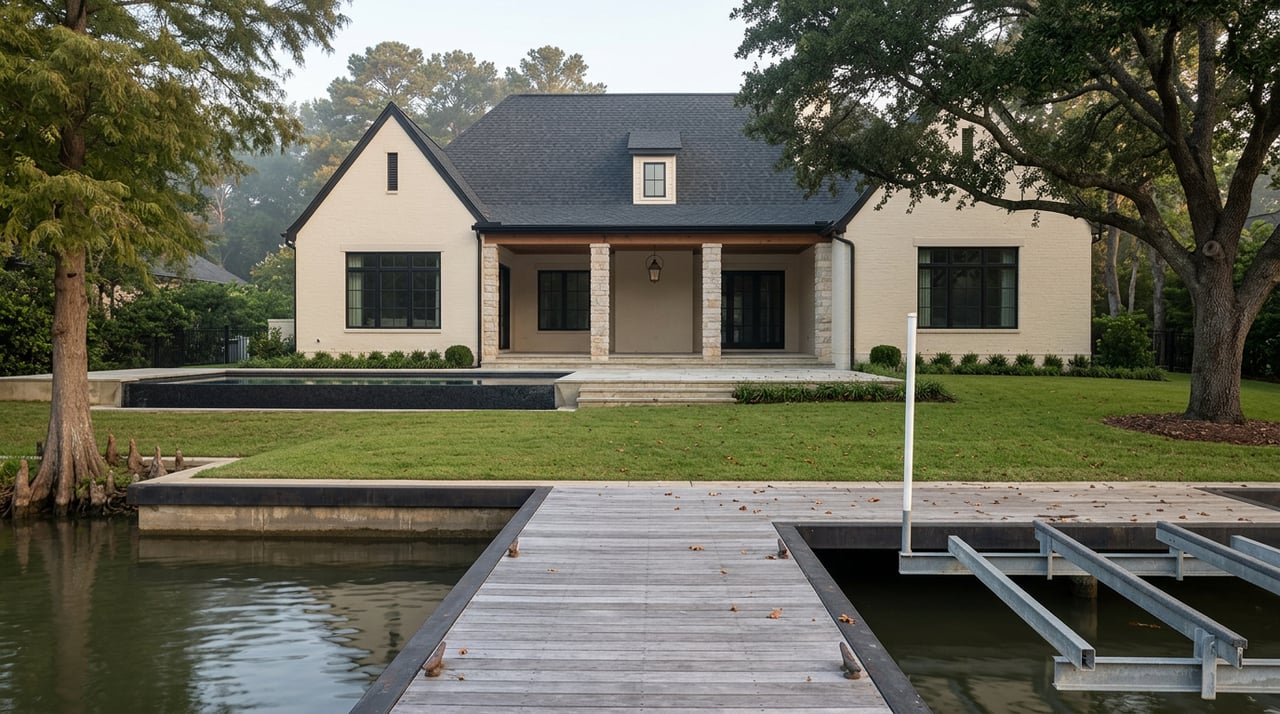
Drive in from Highway 59 on Kingwood Drive and you will pass a sequence of stone entrance signs. Trailwood. Bear Branch. Fosters Mill. Kings Point. Each one looks like a separate community because, in the ways that matter for a closing table, it is. A buyer who treats "Kingwood" as a single market and shops it on a citywide average is comparing homes that were never really competing against each other in the first place.
That distinction sounds like real estate trivia until you are the one signing a resale certificate, budgeting a monthly HOA payment, or discovering that your neighbor two doors down zones to a different school than you do. The village name on the sign tells you when a piece of Kingwood was built and roughly what it was built around. It does not tell you your HOA due, your school zoning, or your closing costs. Those get decided at the street level, not the village level, and conflating the two is where buyers get surprised.
One Name, Twenty-Five Different Housing Stocks
Kingwood was never developed as a single subdivision. Friendswood Development Company, a subsidiary of Exxon, entered a joint venture with King Ranch in 1967 to build the community, and the plan from the start called for a series of distinct villages rather than one continuous neighborhood. Trailwood was the first, with homes completed in 1971. Royal Brook is among the newest, still adding construction with parks, trails, and a community clubhouse.
That forty-plus year build-out is the real driver of what you see on a listing photo. A village's construction era set its lot sizes, its tree canopy, and its house styles before anyone shopping today ever considered buying there. Older villages like Trailwood carry larger original lots and mature trees because that was the standard when they were platted. Newer sections trade some of that lot size and canopy for modern floor plans and amenity packages that didn't exist in the 1970s.
Here is a quick reference for how that plays out across a few well known villages:
| Village | Era | What Defines It |
|---|---|---|
| Trailwood | 1971, Kingwood's original village | Largest original lots, most mature tree cover |
| Bear Branch | Developed 1978 | Established wooded village, pines and oaks throughout |
| Fosters Mill | Established phase | Golf course frontage along Deerwood Club |
| Kingwood Greens | Established phase | Golf course views, direct proximity to Kingwood Country Club |
| Barrington | Gated | The only Kingwood village fully surrounded by a golf course, ringed by the Lakes Course |
| Kings River Estates / Royal Shores | Established, waterfront | Gated, lakefront lots on Lake Houston |
| Royal Brook | Newest active construction | Clubhouse, parks, and trails built into the plan |
None of that is marketing language. It is the physical record of when concrete was poured, and it explains far more about what you are actually buying than the word "Kingwood" on its own ever will.
The Golf and Water Premium Is Real, But It Isn't the Whole Story
It is easy to assume that proximity to golf or water is what separates the pricier villages from the rest, and that assumption isn't wrong so much as incomplete. Barrington sits on more than 200 acres and is the only gated Kingwood community fully engulfed by the Lakes Course of Kingwood Country Club. Deerwood Club, one of the anchor courses in what's known as The Clubs of Kingwood, was designed by Joe Finger, Byron Nelson, and Ken Dye, and its 13th hole is where the final scene of the golf movie Tin Cup was filmed. That kind of pedigree does add a premium, but the bigger price driver is scarcity of the lot type itself, not the game played on it.
The clearest example is waterfront. Kings River Estates, a gated village directly on Lake Houston, spans everything from modest lakefront lots to large custom estates, and that spread exists inside a single village. The label "Kings River" on a listing tells you the lot touches water and sits behind a gate. It does not tell you whether you are looking at an entry-level lakefront property or a custom estate at the top of the range, which means the village name alone is a poor proxy for what any specific address will cost you.
Gating compounds this. A gated golf or waterfront village restricts supply in a way an ungated village of the same construction era does not, and restricted supply is what actually shows up in the price, more than the course or the shoreline view itself.
Your HOA Statement Won't Match Your Neighbor's in the Next Village
Kingwood has 91 separate HOA and condo associations, and the median fee across them runs about $389 a month. That median hides a wide range. Kingwood Village Estates, a 55-plus gated condominium community built in 1996, carries monthly fees anywhere from roughly $382 to $863 depending on unit size and amenity access, which includes clubhouse use, insurance, and utilities bundled into the assessment.
The practical takeaway is that HOA cost tracks the amenity bundle a village committed to decades ago, not the price of the home sitting inside it. Two houses listed at the same price in two different villages can carry meaningfully different monthly obligations once you add the HOA line to your budget. If you are comparing villages on a spreadsheet, the citywide median fee is close to useless. The number you need is the one specific to the subdivision on the deed.
That same fragmented structure creates a real closing-table detail worth knowing before you are under contract. Because most Kingwood villages run their own HOA rather than reporting to one master association, a resale certificate has to come from that specific village's association, not from Kingwood as a whole. Under the Texas Property Owners Association Act, as verified in July 2026, sellers are required to provide 16 specific disclosures in that certificate, the association has 10 days to deliver it once requested, and the preparation fee is capped by statute at $375. If you are selling in one village and your buyer is also selling their current Kingwood home in a different village, you are both waiting on two entirely separate certificates from two entirely separate boards. Requesting yours the day you list, rather than the day you get an offer, is the simplest way to keep that step from slowing down your closing.
The Zoning Assumption That Catches Buyers Off Guard
Every Kingwood village is served by Humble Independent School District, but attendance zones are assigned by street address, not by village boundary, and the district redraws those boundaries as enrollment shifts. That means two homes inside the same village, sometimes on the same street, can be zoned to different campuses. If a specific school assignment matters to your decision, the village name on the entrance sign cannot answer that question. Only a direct address lookup with the district can, and it is worth doing before you write an offer rather than after.
What This Means If You're Comparing Villages
If you are shopping Kingwood right now, the citywide numbers give you a starting point and not much more. Kingwood's average home price sat at $501,832 in August 2026, with an average of $160 per square foot. That figure is a reasonable baseline for the community as a whole, but it is an average built from villages as different as a 1971 Trailwood lot with mature oaks and a gated Kings River Estates lot sitting directly on Lake Houston. Your actual number will land closer to one end of that range or the other depending on the village's era, its amenity structure, and whether it sits on golf frontage, lake frontage, or neither.
The questions worth asking before you get attached to a village are specific. What year was this section developed, and does that match the lot size and tree cover you're seeing in photos? What does this specific HOA charge, and what does that fee actually include? Is the resale certificate process already underway if you're the seller? And if school zoning matters to your family, have you verified the specific address rather than assuming the village name settles it?
Those are the details that separate a comfortable purchase from a surprising one, and they are exactly the kind of village-level homework a longtime local agent walks through with you before you ever make an offer.
If you are weighing which Kingwood village actually fits your budget and your must-haves, Robin Bailey has spent more than 30 years working these specific streets and can walk you through the village-by-village differences that a citywide listing search will never show you. Request Your Free Home Valuation and start the conversation with someone who already knows which HOA fee, which school zone, and which lot size you're actually signing up for.