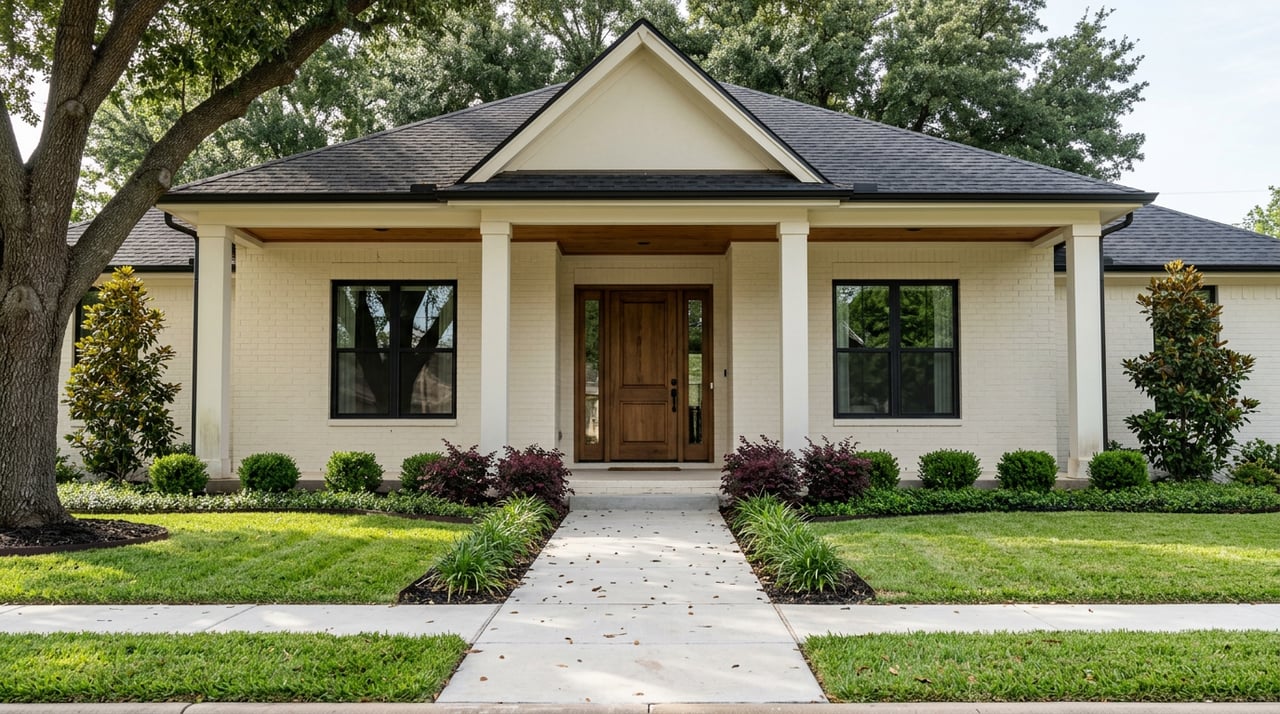
Right now there are two houses for sale in Old Town Spring. One is listed at $475,000. The other is listed at $825,000. Meanwhile, the neighborhood's median sale price over the past year sits at $269,500, and homes there have been closing in about 24 days, according to Homes.com's July 2026 neighborhood data. Cheap and fast is one story. Two active listings priced well into the mid-six figures is a different story entirely. Both are true at the same time, in the same historic district, and the gap between them is the whole point of this post.
If you've been comparing neighborhoods in Spring by pulling up a single "median home price" for the city, you've been reading a number that doesn't describe any actual house. Spring isn't one market wearing one price tag. It's at least two markets, and they're selling two different things to two different kinds of buyers.
The Number That Doesn't Fit
Old Town Spring's housing stock is genuinely split in half. Walk a few blocks west of the shopping district's original 1800s railroad-era buildings and you'll find a mix of small, older homes built before the area's recent growth sitting next to new Mediterranean-style infill construction from the past few years. Homes.com's neighborhood profile puts it plainly: this is where some of the city's oldest storefronts sit a short walk from some of Spring's newest houses. That's why the median sale price ($269,500) and the average sale price ($364,780) aren't close to each other. A median tells you what the middle house sold for. An average gets pulled upward by the handful of larger new builds mixed into a small, older inventory pool. When you only have a couple of listings active at any given time, as Old Town Spring typically does, one $825,000 new build can bend the average without moving the median at all.
That thin inventory is also why homes there move fast. Redfin's citywide figures for Spring put average days on market at 77 as of March 2026, more than three times Old Town Spring's 24-day pace. A neighborhood doesn't sell that quickly because it's cheap. It sells that quickly because the buyers who want it are specific about wanting it, and there are rarely more than a couple of houses for them to choose from at once.
What Cheap and Fast Actually Means Here
The buyers drawn to Old Town Spring aren't shopping for square footage. They're shopping for the ability to walk to more than 100 shops and restaurants housed in the district's original buildings, places like CorkScrew BBQ, ranked among Houston's top barbecue spots, the Wunsche Bros. Café & Saloon, Thad's antique shop, The Doll Hospital, and the 1920s-themed Prohibition Texas Bar. Preservation Park hosts the neighborhood's monthly concerts and community events, and Dennis Johnston Park, a mile north, connects to the Spring Creek Greenway, a nearly 40-mile stretch of trail running from Rayford up past George Bush Intercontinental Airport.
That trade shows up structurally, too. Unlike Gleannloch Farms or Augusta Pines, Old Town Spring's residential streets grew up around a historic commercial district rather than a developer's master plan, so there's no subdivision-wide association collecting dues to fund a shared clubhouse or pool. One recent listing inside the district captured that flexibility directly: a property was marketed as three separate structures, a 1,388-square-foot commercial storefront, a garage apartment, and a third leasable unit, with the listing noting that ample on-site parking is rare to find in Old Town Spring. That kind of live-work mixing is what happens in a district that grew organically rather than under a single HOA's design guidelines. For a buyer, it can mean real flexibility. It also means no shared amenities and no guarantee that the house next door matches your renovation.
The Other Spring: Paying a Lifestyle Fee Every Month
A few miles away, Spring's master-planned communities are selling something almost opposite: predictability, wrapped in amenities, paid for monthly.
Gleannloch Farms is the community that comes up most often in conversations about family-friendly Spring. Homes there start in the $280Ks and run past $4 million for estate sections, with annual HOA dues ranging from $1,100 to $1,741 depending on the section, according to a March 2026 market breakdown. Those dues fund three recreation centers, the Gleannloch Pines Golf Club, an equestrian center, and miles of trails. Augusta Pines runs on a similar model: 30 acres of lakes, an 18-hole golf course, a 33-acre equestrian facility called Augusta Pines Farms, and its own on-site restaurant, The Augusta Bar & Grill. Windrose centers its pitch on a 20-acre lake, two pools, and a soccer field, and Woodson's Reserve leans on catch-and-release lakes and a resort-style pool with a splash pad, amenities substantial enough that Homes.com notes homes there tend to run near the million-dollar mark even though they sit in the same broader Old Town Spring area as $269,500 median sales just down the road.
None of that shows up in a portal's headline sale price. A buyer comparing a $450,000 listing in Gleannloch Farms against a $450,000 listing in Old Town Spring is not comparing two versions of the same product. One comes with a golf course membership option and a shared equestrian center funded by a five-figure annual dues commitment over time. The other comes with a five-minute walk to a working antique shop and zero recurring amenity fee.
| Old Town Spring | Spring's Master-Planned Communities | |
|---|---|---|
| Median sale price | $269,500 (12-month trailing, July 2026) | Starts in the $280Ks (Gleannloch Farms) |
| Typical days on market | 24 days | Varies; citywide average 77 days |
| Annual HOA dues | No subdivision-wide HOA | $1,100–$1,741+ (Gleannloch Farms) |
| What the price buys | Walkability, historic character, fewer covenants | Golf, pools, equestrian centers, planned amenities |
Why the Same City Produces Two Different Median Prices
Here's the part that should make any buyer skeptical of a single "Spring, TX median price" headline. Redfin's data for March 2026 puts Spring's citywide median sale price at $236,000. Zillow's figure for the same city, measured in June 2026, comes in at $317,883, nearly $82,000 higher. That's not one data provider being sloppy. It's evidence that a citywide median for Spring is trying to average a $269,500 historic walkable pocket against a $280,000-to-$4-million golf course community against dozens of subdivisions in between, and depending on which slice of sales a given tool happens to weight more heavily, the answer moves by tens of thousands of dollars. The number that comes out the other end doesn't describe any specific house a buyer is actually going to look at.
That's the real lesson for anyone using Spring as a search term on a portal. The citywide figure is a starting point for a search, not a planning number. The neighborhood-level number, and what that neighborhood is actually built to offer, is what should shape a budget.
What This Means If You're Comparing Neighborhoods Right Now
Texas overall is giving buyers more room to negotiate than it has in years. Statewide, homes were averaging 64 days on the market in May 2026, with 5.3 months of active supply and median seller price cuts running about $12,000, or 3.4 percent of the original list price, according to the Texas Real Estate Research Center's most recent housing report. That broader slack matters if you're eyeing a master-planned community like Gleannloch Farms or Augusta Pines, where inventory tends to be deeper and sellers are more likely to negotiate on price or closing costs.
It matters less if Old Town Spring specifically is where you want to land. With only a couple of active listings at any given time and a 24-day average time on market, that pocket behaves like a seller's market even while the region around it loosens up. If you find a house there that fits, moving quickly still matters more than waiting for a price cut that may never come.
Either way, the decision isn't really about which number is smaller. It's about which currency you'd rather pay in: a monthly HOA line item for golf and pools, or the trade-off of fewer shared amenities in exchange for walking to CorkScrew BBQ on a Friday night.
A Few Questions Worth Asking Before You Choose
Is all of Old Town Spring historic, or is some of it new construction? Both. The commercial shopping district dates to the 1800s, but the surrounding residential streets include contemporary houses and townhomes built from the 2000s onward, which is why prices there range from properties in the $200,000s up through new builds priced well into the $700,000s and $800,000s.
Do all of Spring's master-planned communities charge similar HOA dues? No. Gleannloch Farms dues run $1,100 to $1,741 a year depending on section. Other communities set their own rates tied to whichever amenities they maintain, so it's worth asking for the specific HOA budget and reserve study before assuming any number.
Does Old Town Spring have a homeowners association like the master-planned communities do? Not in the way Gleannloch Farms or Windrose do. The historic district grew up around its shopping streets rather than as a single planned subdivision, so there's no association-run clubhouse or pool covering the whole neighborhood. That gives owners more flexibility, but it also means no shared amenities and no architectural review to keep the block consistent. Always confirm the specific restrictions on any individual property before assuming there are none.
Comparing a walkable historic district against a golf course community isn't really a math problem. It's a question about which trade-offs fit how you actually want to live, and that's easier to work through with someone who knows both sides of Spring block by block. If you're trying to figure out which version of this city fits your next move, Robin Bailey can walk you through what a given price actually buys in each neighborhood. Request your free home valuation to start the conversation with real numbers for your specific situation, not a citywide average.